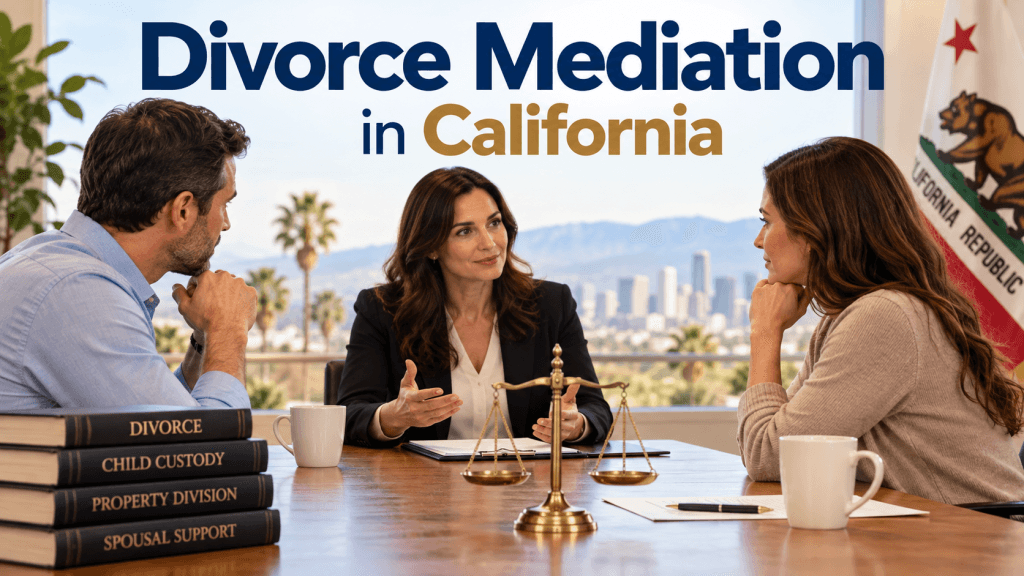
Divorce mediation gives California spouses a way to work toward an agreement without asking a judge to decide every disputed issue.
In private divorce mediation, a neutral mediator helps both spouses discuss property, debts, spousal support, parenting issues, child support, and other divorce terms. The mediator does not make decisions for the spouses and does not represent either person.
If the spouses reach an agreement, the terms can be put into writing and submitted to the court as part of the final divorce judgment.
Mediation is different from California court-connected child custody mediation. Court custody mediation generally focuses only on child custody and parenting time, while private divorce mediation can potentially address most or all issues in a divorce.
This guide explains how divorce mediation works in California, what it costs, what happens during mediation sessions, what documents to prepare, what a mediator can and cannot do, and what happens if you reach an agreement or cannot settle.
CD&D Associates is a registered Legal Document Assistant service, not a law firm. This article provides general information, not legal advice. We prepare California divorce and settlement documents at your direction. A mediator, attorney, tax professional, financial professional, or other specialist may be appropriate depending on the issues in your case.
What Is Divorce Mediation in California?
Divorce mediation is a negotiation process in which both spouses work with a neutral third party called a mediator.
The mediator helps the spouses:
- Identify the issues that need to be resolved
- Exchange relevant information
- Discuss possible solutions
- Identify areas of agreement and disagreement
- Negotiate settlement terms
- Work toward a written agreement
The mediator does not act like a judge.
A mediator generally does not decide:
- Who gets the house
- How much support should be paid
- How property should be divided
- What parenting schedule should be used
Instead, the spouses make those decisions themselves if they can reach an agreement.
California Courts recognizes mediation as one way spouses can get help reaching an agreement before asking a judge to decide disputed issues.
Is Divorce Mediation Required in California?
Full private divorce mediation is generally not required simply because you filed for divorce.
Spouses may voluntarily choose mediation to resolve issues such as:
- Property division
- Debt division
- Spousal support
- Parenting arrangements
- Child support
- Other settlement terms
Child custody disputes are different.
If parents have a court dispute about custody or parenting time, California generally requires them to attend court-connected custody mediation before the judge decides the issue.
That process is usually handled through Family Court Services.
It should not be confused with private full-divorce mediation.
Private Divorce Mediation vs Court Custody Mediation
These are two different processes.
| Type | Main purpose | Issues covered | Cost |
| Private divorce mediation | Reach a full or partial divorce settlement | Property, debts, support, parenting, and other agreed issues | Private mediator charges fees |
| Court custody mediation | Help parents resolve custody and parenting-time disputes | Legal custody, physical custody, parenting time | Often through Family Court Services; programs and charges vary by county |
California Courts explains that court custody mediation focuses on the children’s best interests and parenting arrangements.
It does not resolve property division or spousal support.
What Does a Divorce Mediator Do?
A divorce mediator is a neutral facilitator.
The mediator may:
- Help organize discussions
- Explain the mediation process
- Keep negotiations focused
- Help spouses identify possible solutions
- Help clarify disputed issues
- Encourage exchange of information
- Help spouses work toward compromise
- Record or summarize agreements depending on the service provided
The mediator should remain neutral.
The mediator does not represent either spouse.
Can a Divorce Mediator Give Legal Advice?
A neutral mediator does not act as either spouse’s personal lawyer.
An attorney-mediator may be able to provide general legal information during mediation, but cannot represent both spouses as their individual advocate.
If you want advice about whether a proposed settlement protects your personal legal interests, you may choose to consult your own attorney.
Some spouses mediate without separate attorneys.
Others use attorneys only for limited consultation or agreement review.
Is Divorce Mediation Confidential?
Private divorce mediation is generally confidential. A private mediator cannot report what was said in mediation to the judge, which is part of what lets spouses negotiate openly.
Court-connected custody mediation can work differently. In some counties, that process can result in a recommendation to the judge about custody and parenting time, and it is not confidential in the same way. Because the rules and programs vary by county, confirm how confidentiality works in your court.
What Issues Can Be Resolved Through Divorce Mediation?
Private mediation can potentially resolve most issues in a California divorce.
Common subjects include:
- Community property
- Separate property claims
- Family home
- Retirement accounts
- Debts
- Vehicles
- Bank accounts
- Business interests
- Spousal support
- Child custody
- Parenting time
- Child support
- Insurance
- Tax issues
- Future sale of property
- Responsibility for expenses
For general property rules, see our guide to community property in a California divorce.
How Does Divorce Mediation Work in California?
The exact process depends on the mediator and complexity of the case, but private divorce mediation commonly follows several stages.
Step 1 – Choose a Mediator
Both spouses agree on a mediator.
A divorce mediator may be:
- A family law attorney
- A retired judge
- A mental health professional with mediation training
- Another qualified mediator
Before hiring a mediator, ask about:
- Experience with California divorce
- Hourly or flat fees
- Minimum session length
- Deposits or retainers
- Whether document drafting is included
- Whether attorneys can attend
- Virtual or in-person sessions
- Experience with complex property or custody issues
Step 2 – Identify the Issues
The mediator identifies what needs to be resolved.
This can include:
- Property
- Debts
- Support
- Children
- Retirement
- Real estate
- Other financial or parenting issues
Some couples already agree on most issues and use mediation only for the remaining disagreements.
Others use mediation for the entire settlement.
Step 3 – Exchange Financial Information
A meaningful financial settlement requires accurate financial information.
Spouses may need to exchange documents involving:
- Income
- Expenses
- Bank accounts
- Retirement accounts
- Real estate
- Loans
- Credit cards
- Investments
- Business interests
- Tax returns
Mediation does not replace California’s required divorce financial disclosures.
For the formal disclosure process, see our guide to California divorce financial disclosure requirements.
Step 4 – Attend Mediation Sessions
During mediation, the spouses discuss one or more issues with the mediator.
Sessions may be:
- In person
- By video
- Joint sessions
- Separate discussions with the mediator in some mediation models
Private family law mediation sessions often last a few hours, although the format varies.
Riverside Superior Court notes that many private mediation sessions last at least 2 to 3 hours and that some cases require multiple sessions.
Step 5 – Negotiate Possible Solutions
The mediator helps the spouses explore possible settlement terms.
For example, they might discuss:
- Selling the house
- One spouse buying out the other
- Dividing retirement accounts
- Allocating debts
- Setting a parenting schedule
- Determining support
- Dividing household expenses
The spouses decide whether to accept or reject proposed terms.
Step 6 – Reach a Full or Partial Agreement
Mediation does not have to resolve every issue.
You may reach:
- A full settlement
- A partial settlement
- No settlement
If only some issues are resolved, those agreements may still reduce what remains for the court to decide.
Step 7 – Put the Agreement in Writing
California Courts explains that when spouses reach an agreement, it must be written down and submitted for the judge’s approval.
Depending on the case, the written agreement may address:
- Property
- Debts
- Spousal support
- Child custody
- Parenting time
- Child support
- Other divorce terms
A marital settlement agreement can document the spouses’ final terms.
Step 8 – Submit Final Divorce Paperwork
Mediation itself does not divorce you.
The spouses still need to complete the required California court process.
That may include:
- Filing the divorce case
- Completing service or the applicable joint filing process
- Exchanging financial disclosures
- Preparing the agreement
- Preparing judgment forms
- Submitting the final packet
- Waiting for the required minimum divorce period
See our California divorce timeline guide for the broader process.
How Much Does Divorce Mediation Cost in California?
Private mediation fees vary significantly.
The cost can depend on:
- Mediator’s experience
- Location
- Number of sessions
- Complexity of property
- Custody disputes
- Business interests
- Retirement plans
- Outside experts
- Amount of preparation and drafting
Riverside Superior Court currently states that private family law attorney-mediators on its program generally charge approximately $150 to $500 per hour.
As a broader reference point, San Diego Superior Court’s general civil mediation materials note private mediator market rates of roughly $200 to $1,000 per hour; the Riverside family-law figure above is the more directly relevant one for divorce mediation.
These are examples, not statewide fixed prices.
Always ask the mediator directly for current fees.
Who Pays for Divorce Mediation?
The spouses decide how private mediation fees will be paid.
Common arrangements include:
- Splitting the cost equally
- Paying from community funds
- One spouse paying more by agreement
- Another agreed allocation
Court-connected custody mediation programs vary by county. Some, such as Riverside’s program, do not charge the parties directly, while other counties handle it differently.
Private mediation fees are separate from California court filing fees.
For general divorce expenses, see our California divorce cost guide.
How Many Mediation Sessions Will You Need?
There is no fixed number.
A relatively simple case may require only a few sessions.
A more complicated divorce may require several sessions.
Factors include:
- Number of disputed issues
- Complexity of finances
- Number of properties
- Business ownership
- Retirement division
- Parenting disagreements
- Whether financial information is complete
- How quickly spouses can compromise
Do not assume another couple’s mediation timeline will predict yours.
How Long Does Divorce Mediation Take?
Mediation itself can take weeks or months depending on the case.
But completing mediation does not eliminate California’s minimum six-month waiting period. A California divorce generally cannot be final until at least six months have passed from service of the Summons and Petition or the respondent’s appearance, depending on the case; in a joint petition case, the six-month period starts when the joint petition is filed. Mediation can reduce conflict and speed up the paperwork, but it does not shorten that statutory waiting period.
What If You Cannot Reach an Agreement?
Not every mediation ends in a full settlement, and that is normal. If you settle only some issues, those agreements can still be put in writing and submitted to the court, which narrows what a judge has to decide. For the issues that remain in dispute, the case continues through the normal court process, and a judge decides them. A partial agreement can reduce the number of issues that remain for the court to decide.
When Mediation May Not Be the Right Fit
Mediation works best when both spouses can negotiate on relatively equal footing. It may not be appropriate when there is a significant power imbalance between the spouses, or where there is physical or emotional abuse. In those situations, open negotiation can be unsafe or one-sided, and a different process – with the protection of the court or an attorney – may be more appropriate. If safety is a concern, that comes first.
How CD&D Associates Can Help
CD&D Associates is not a mediator, and we do not take sides. What we do is prepare the California divorce paperwork that turns a mediated agreement into a completed case – the marital settlement agreement, the required disclosures, and the judgment forms – based on the terms you and your spouse agreed to, as part of our divorce document preparation service, at a flat fee for document preparation. We serve Santa Maria, Lompoc, Buellton, and all of California by phone or Zoom. If your issues are complex or contested, a mediator, attorney, or financial professional may be appropriate. Contact us for a free consultation.
Frequently Asked Questions
How much does divorce mediation cost in California?
It varies by mediator and case. Court program figures give a sense of the range – Riverside Superior Court lists roughly $150 to $500 per hour for attorney-mediators, and San Diego Superior Court notes market rates of about $200 to $1,000 per hour. These are examples, not fixed statewide prices, so ask the mediator for current fees.
Is divorce mediation required in California?
Private full-divorce mediation is generally voluntary. However, if parents have a court dispute over custody or parenting time, California generally requires court-connected custody mediation before a judge decides that issue.
Is divorce mediation the same as court custody mediation?
No. Private divorce mediation can address most or all divorce issues – property, debts, support, and parenting. Court custody mediation, usually through Family Court Services, focuses only on custody and parenting time and does not resolve property or support.
Can a divorce mediator give legal advice?
A neutral mediator does not act as either spouse’s personal attorney. An attorney-mediator may share general legal information but cannot represent either spouse individually. For advice about your own interests, you can consult your own attorney.
Does mediation make my divorce final?
No. Mediation helps you reach an agreement, but you still have to complete the California court process and wait out the minimum six-month period before the divorce can be final.
What happens if we only agree on some issues?
A partial agreement still counts. The resolved issues can be submitted to the court in writing, and only the remaining disputes go to the judge, which reduces the number of issues the court has to decide.