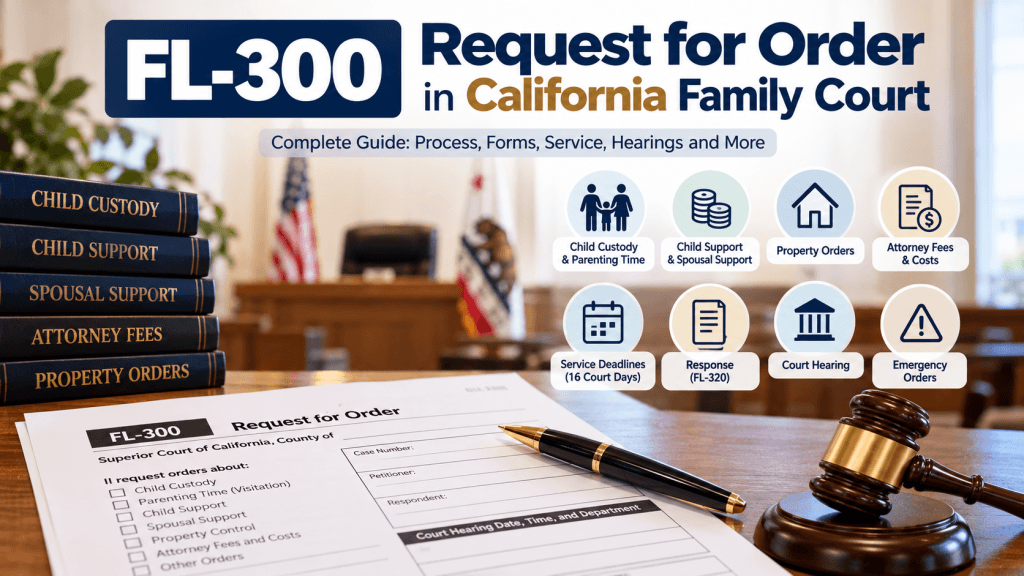
Form FL-300, Request for Order, is one of the most commonly used forms in California family court.
It allows a person who already has a family law case to ask a judge to make a new order, change an existing order, or make certain temporary orders while the case is pending.
Depending on the situation, FL-300 can be used to ask for orders involving child custody, parenting time, child support, spousal support, property control, attorney fees, and other family law issues.
Filing the form does not mean the judge automatically grants what you ask for. It normally starts a process that includes filing the request, serving the other party, allowing that person to respond, and attending a court hearing.
This guide explains what Form FL-300 is, when it is used, which additional forms may be required, how service works, how the other party responds, what happens at the hearing, and how the process differs for emergency requests.
CD&D Associates is a registered Legal Document Assistant service, not a law firm. This article provides general information, not legal advice. We prepare California family law documents at your direction. Choosing what orders to request, deciding what legal arguments to make, or handling contested hearings may require advice from an attorney or court self-help center.
What Is Form FL-300?
FL-300 is called Request for Order.
In California family court, it is generally used when a person wants a judge to make a decision about a specific issue in an existing family law case.
The form also allows the court to set the date, time, and location of the hearing.
You may hear lawyers or court staff use words such as:
- Request for Order
- RFO
- Motion
- Family law motion
- Request for temporary orders
In California family law, a Request for Order serves a similar function to what is traditionally called a motion.
When Can You File an FL-300?
You can use FL-300 while your family law case is pending.
You can also use it in many situations after a judgment has already been entered when you need to ask the court to change or enforce an order.
Examples include asking for:
- A first custody order
- A change to custody
- A parenting-time schedule
- A change to parenting time
- Child support
- A change to child support
- Temporary spousal support
- A change to certain support orders
- Property control
- Payment of certain bills
- Attorney fees and costs
- An order requiring financial disclosures
- Other family law orders
The correct process depends on what you are asking the court to decide.
What Can You Ask for on FL-300?
The first page of FL-300 includes several common categories.
These include:
- Child custody
- Visitation or parenting time
- Child support
- Spousal or domestic partner support
- Property control
- Attorney fees and costs
- Other orders
You can sometimes request more than one type of order using the same FL-300.
For example, a parent may request custody, parenting time, and child support in the same Request for Order.
Additional forms and attachments may be required for each type of request.
FL-300 at a Glance
| Issue | FL-300 used? | Common additional forms |
|---|---|---|
| Child custody | Yes | FL-311 or other custody attachments may apply |
| Parenting time | Yes | FL-311 may be used |
| Child support | Yes | FL-150 or FL-155 may be required |
| Spousal support | Yes | FL-150 generally required |
| Attorney fees | Yes | FL-150, FL-319, and supporting declaration may apply |
| Property control | Yes | Additional declaration or attachments may apply |
| Change existing order | Yes | Depends on order being changed |
| Respond to FL-300 | No | Use FL-320 |
| Domestic violence restraining order | Different process may apply | DV forms generally used |
Always confirm the forms required for the specific order you are requesting.
Can FL-300 Be Used for Temporary Orders?
Yes.
One common reason to file an FL-300 during a divorce is to request temporary orders while the case is still pending.
A divorce can take months or longer to finish.
During that time, spouses or parents may need temporary rules about:
- Where children will live
- Parenting schedules
- Child support
- Spousal support
- Who may use certain property
- Who pays certain expenses
- Attorney fees
Temporary orders can remain in effect until they are changed, replaced, or superseded by later orders or judgment.
They are not necessarily the same as the final terms of the divorce.
Can FL-300 Be Used After the Divorce Is Final?
Yes, in many situations.
FL-300 can be used after judgment when a person wants the court to change certain existing family law orders.
Common examples include:
- Modifying child custody
- Modifying parenting time
- Changing child support
- Changing modifiable spousal support
- Requesting other post-judgment orders
The person asking for a modification may need to show facts that satisfy the legal standard for changing that particular type of order.
CD&D Associates can prepare forms based on your instructions, but cannot determine whether you meet the legal standard for a modification.
FL-300 Is Not a New Divorce Case
Form FL-300 normally belongs inside an existing family law case.
It does not replace the Petition for divorce.
If you have not opened the appropriate family law case yet, you may first need to file a divorce, parentage, or other qualifying family law case.
For divorce forms generally, see our California divorce forms guide.
Important 2026 Rule for Joint Petition Divorce Cases
California introduced a regular joint petition divorce process in 2026.
If spouses started their divorce through a joint petition and judgment has not yet been entered, a spouse who wants to file a Request for Order generally must revoke the joint petition before or at the same time as filing the FL-300.
The revocation process uses Notice of Revocation of Joint Petition, Form FL-720.
This is a new issue that older FL-300 guides may not address.
If your divorce started through the joint petition procedure, confirm the current requirements before filing an RFO.
How to File an FL-300 in California
The process generally involves several steps.
Step 1 – Decide What Order You Are Requesting
First identify exactly what you want the judge to order.
For example:
- A specific parenting schedule
- A specific child support order
- Temporary spousal support
- Use of the family home
- Payment of certain bills
Your request should be clear enough that the other party understands what you are asking the court to decide.
Step 2 – Complete Form FL-300
Fill out the Request for Order.
You will generally identify:
- Your case
- The parties
- What orders you want
- Whether you are asking to change an existing order
- The facts supporting your request
- Any related information required by the form
The current FL-300 is a mandatory Judicial Council form.
Use the current version.
Step 3 – Prepare the Required Attachments
FL-300 is often not the only document needed.
The attachments depend on the type of order requested.
Custody and Parenting Time
A custody request may require additional custody information or an attachment such as FL-311.
Child Support
Child support requests commonly require financial information.
Depending on the case, this may include FL-150, Income and Expense Declaration, or another permitted financial form.
Spousal Support
A request for spousal support generally requires a current FL-150.
Attorney Fees
An attorney-fee request can require:
- FL-300
- FL-150
- FL-319 or equivalent information
- A supporting declaration
- Other relevant financial information
Other Orders
Property control or other specialized requests may require declarations or supporting documents.
The exact paperwork depends on what you want the judge to decide.
Step 4 – Include Supporting Facts
An FL-300 must explain the facts supporting the requested orders.
Avoid simply writing:
“I want custody.”
or:
“I need support.”
The court needs enough information to understand why you are asking for the order.
Supporting facts can sometimes include:
- Current arrangements
- Dates
- Existing orders
- Changes in circumstances
- Income information
- Expense information
- Parenting schedules
- Relevant events
Complex legal arguments or disputed facts may require legal advice.
Can You Attach Evidence to an FL-300?
Yes.
Documents or declarations can sometimes be filed with the FL-300 to support the request.
Examples may include:
- Financial records
- Pay statements
- School information
- Relevant communications
- Prior orders
- Written declarations
- Other documents related to the requested order
Private information should be protected where required.
Do not submit unnecessary documents merely because you have them.
The evidence should relate to what you are asking the judge to decide.
Step 5 – File the FL-300 With the Court
File the completed documents in the existing family law case.
The court will generally assign a hearing date.
Depending on the court, filing may be available:
- In person
- By mail
- Through electronic filing
Local procedures vary.
Is There a Filing Fee for FL-300?
There may be a filing fee.
The exact fee depends on the filing, your case, and whether you have already paid a first appearance fee.
If you cannot afford qualifying court fees, you may be able to request a fee waiver.
See our California divorce filing fee and fee waiver guide for information about FW-001 and court fee waivers.
Step 6 – Get the Filed Copies Back
After filing, the court will normally return filed copies showing information such as:
- Hearing date
- Hearing time
- Department or location
- Any orders the court made before the hearing
- Whether mediation or another step is required
Read the filed FL-300 carefully.
Do not assume the only important information is the hearing date.
Step 7 – Serve the Other Party
The other party must receive proper notice of the Request for Order.
You normally cannot serve the papers yourself.
The server generally must:
- Be at least 18
- Not be a party to the case
How service may be completed depends on the case.
Some requests can be served by mail.
Others require personal service.
How Many Days Before the Hearing Must FL-300 Be Served?
The service deadline is one of the most important parts of the process.
California Courts generally requires a Request for Order to be served at least 16 court days before the hearing unless a different deadline applies.
Additional time may be required depending on the method of service.
For example, service by mail normally requires additional calendar days.
Out-of-state or international service can require even more time.
Always calculate the deadline from the actual hearing date and the method of service.
When Is Personal Service Required?
Personal service may be required in situations such as:
- Temporary emergency orders were granted
- The other party has not yet appeared in the case
- The court specifically orders personal service
Other requests may qualify for service by mail.
Post-judgment custody, visitation, or child-support requests can have additional address-verification requirements.
FL-330 vs FL-335
Two common proof-of-service forms are:
FL-330 – Proof of Personal Service
Use this when the papers were personally delivered.
FL-335 – Proof of Service by Mail
Use this when qualifying papers were served by mail.
The server, not the requesting party, signs the proof of service.
The completed proof should be filed with the court.
Do You Serve a Blank FL-320?
Yes.
A blank Responsive Declaration to Request for Order, Form FL-320, generally must be served with the FL-300.
If you served your own completed Income and Expense Declaration, the applicable blank financial form may also need to be included.
What Is Form FL-320?
FL-320 is the Responsive Declaration to Request for Order.
It allows the other party to tell the court:
- Whether they agree
- Whether they disagree
- What orders they want
- Why they take that position
FL-320 is the response form.
It is not another FL-300.
How Long Does Someone Have to Respond to FL-300?
California Courts currently states that a response should generally be filed and served at least 9 court days before the hearing.
Court days exclude weekends and court holidays.
The hearing date is therefore important immediately after someone receives an FL-300.
Ignoring the papers does not stop the hearing.
What Happens If You Do Not Respond to an FL-300?
The court can still hold the hearing.
If you do not respond or appear, the judge may make decisions based on the requesting party’s papers and available evidence without your input.
If you received an FL-300, read:
- The hearing date
- Requested orders
- Any temporary orders
- Any mediation requirement
- Response deadline
as soon as possible.
What Happens If FL-300 Involves Child Custody?
If custody or parenting time is disputed, the parents will generally need to participate in court-connected custody mediation before the judge decides the disputed issue.
This usually occurs through Family Court Services.
The exact process can vary by county.
For the difference between private divorce mediation and court custody mediation, see our divorce mediation in California guide.
What Happens at an FL-300 Hearing?
At the hearing, the judge considers the requests and responses.
Depending on the issue, the judge may review:
- FL-300
- FL-320
- Declarations
- Financial forms
- Exhibits
- Existing orders
- Mediation information
- Arguments from the parties or attorneys
- Other admissible evidence
The judge may:
- Grant the requested order
- Deny it
- Modify the requested terms
- Continue the hearing
- Request additional information
- Make another order permitted by law
The outcome depends on the issue and evidence.
Can You Reach an Agreement Before the Hearing?
Yes.
If the parties reach an agreement, they may be able to submit the agreement to the court as a proposed order.
In some situations, the hearing can then be taken off calendar.
Do not simply skip a scheduled hearing because you reached an informal agreement.
Make sure the court has accepted the agreement and confirmed whether the hearing is still required.
What Is a Temporary Emergency Order?
FL-300 also has a section for requesting temporary emergency orders.
These are commonly called emergency or ex parte orders.
They are different from an ordinary Request for Order.
An emergency request asks the court to act before the regularly scheduled hearing because waiting for the normal hearing could create a serious problem.
Emergency orders have additional procedural requirements.
When Can You Ask for Emergency Orders?
Emergency family law orders are intended for qualifying urgent circumstances.
Examples can involve immediate risk or harm relating to:
- A child
- Property
- Safety
- Other urgent family law matters recognized by the court
An emergency request should not be used simply because a person wants a faster court date.
The legal standard for emergency relief can be fact-specific.
For disputed emergency issues, consider consulting an attorney or court self-help center.
Is FL-300 Used for a Domestic Violence Restraining Order?
Not for every restraining-order request.
California has separate Domestic Violence Prevention Act forms for restraining orders.
For example, different DV forms are used to request a domestic violence restraining order or change certain existing DV orders.
Do not assume FL-300 is the correct form simply because the family law issue involves safety or conflict.
See our California DVRO document preparation guide for the separate restraining-order process.
Can FL-300 Be Used to Change Child Support?
Yes, when there is an existing family law case and the procedural requirements are met.
A parent may use FL-300 to ask the court to change a child support order.
Financial forms are generally required.
The party requesting the change should explain what has changed and what new order is being requested.
See our guide on changing child support or spousal support in California for the broader modification rules.
Can FL-300 Be Used to Change Custody?
Yes.
FL-300 is commonly used to request a new or modified custody or parenting-time order in an existing family law case.
But filing the form is only the procedural step.
The legal standard the judge applies can depend on the existing custody order and case history.
For broader modification information, see our guide on how to modify a custody agreement in California.
Can You Request More Than One Order on the Same FL-300?
Yes, in many cases.
For example, you might ask for:
- Child custody
- Parenting time
- Child support
on the same Request for Order.
Or you might request:
- Spousal support
- Attorney fees
- Property control
The attachments and evidence required for each issue still need to be included.
Can You Use FL-300 to Force Financial Disclosures?
California Courts lists failure to complete financial disclosures as an example of an “other” issue that can be raised through an FL-300.
You would generally use the “Other” section and explain the order you want.
Some specialized requests involve additional legal requirements.
For general disclosure requirements, see our California divorce financial disclosure guide.
What If Both Sides Agree?
If both parties agree on the requested orders, a contested hearing may not always be necessary.
They may be able to submit a written agreement for the judge to approve.
The correct forms depend on the type of agreement.
A signed agreement does not automatically become a court order until the court accepts and enters it where required.
Common FL-300 Mistakes
Asking for an Order Without Saying Exactly What You Want
The judge and other party need to understand the requested terms.
Be specific.
Leaving Out Required Attachments
Different requests require different supporting forms.
An FL-300 by itself may not be enough.
Missing the Service Deadline
A correctly completed FL-300 can still create problems if it is served late.
Serving the Papers Yourself
A party generally cannot act as their own server.
Using Mail When Personal Service Is Required
The correct service method depends on the circumstances.
Forgetting the Blank FL-320
The responding party generally must receive a blank response form.
Ignoring Local Rules
California uses statewide forms, but counties can have local procedures.
Using FL-300 for the Wrong Type of Request
Some family law matters use specialized forms instead.
Assuming Filing Means the Request Was Granted
The request normally remains just that – a request – until a judge makes an order.
Confusing FL-300 With FL-320
FL-300 starts the request.
FL-320 responds to it.
How CD&D Associates Can Help
CD&D Associates prepares California family law paperwork at your direction.
If you have decided what court orders you want to request, document preparation may include:
- Form FL-300
- Applicable custody attachments
- Financial forms
- Supporting declarations based on information you provide
- Service forms
- Other required family law documents
We can also prepare responsive paperwork when you have received an FL-300 and provide us with the response terms you want documented.
CD&D Associates cannot advise you what orders to request, determine what legal arguments you should make, predict what a judge will decide, or represent you at the hearing.
For California family law document preparation, contact CD&D Associates.
Frequently Asked Questions
What is FL-300 in California?
FL-300 is Request for Order. It is used in an existing California family law case to ask a judge to make or change certain court orders.
What can I request with FL-300?
Common requests include child custody, parenting time, child support, spousal support, property control, attorney fees, and other family law orders.
Can I use FL-300 to change an existing order?
Yes. FL-300 is commonly used to request changes to modifiable family law orders.
What is the difference between FL-300 and FL-320?
FL-300 is the Request for Order. FL-320 is the Responsive Declaration used by the other party to respond.
How long before the hearing must FL-300 be served?
A Request for Order generally must be served at least 16 court days before the hearing, with additional time depending on the service method and location of the other party.
Can I serve FL-300 by mail?
Some Requests for Order may be served by mail. Other situations require personal service. The correct method depends on the case and the orders requested.
Do I have to serve a blank FL-320?
Yes. A blank FL-320 generally must be served with the FL-300.
How long does the other side have to respond?
California Courts currently states that FL-320 should generally be filed and served at least 9 court days before the hearing.
Is there a filing fee for FL-300?
There may be a court fee depending on the filing and case. A person who cannot afford qualifying court fees may request a fee waiver.
Do I have to attend mediation if FL-300 involves custody?
When child custody or parenting time is disputed, parents generally must participate in court-connected custody mediation before the judge decides the issue.
Can I ask for emergency orders with FL-300?
FL-300 includes a process for requesting temporary emergency orders, but emergency requests have additional requirements and are intended for qualifying urgent situations.
Can I use FL-300 after my divorce is final?
Yes, in many cases. It can be used to request changes to certain existing orders after judgment.
Can I file FL-300 during a 2026 joint petition divorce?
If judgment has not yet been entered in a joint petition case, current California rules generally require revoking the joint petition using FL-720 before or at the same time as filing the Request for Order.
Does filing FL-300 guarantee a court order?
No. Filing FL-300 asks the judge to make an order. The judge decides after reviewing the request, any response, evidence, and applicable law.