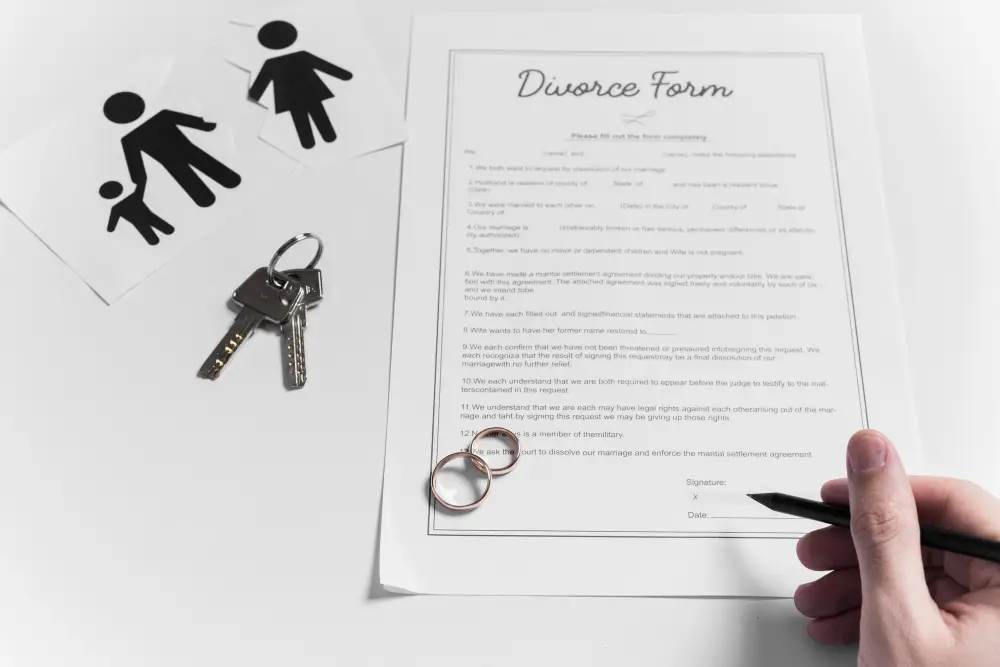
One of the first questions people ask when considering divorce is whether they really need to hire a lawyer. Attorney fees for a divorce in California can range from a few thousand to tens of thousands of dollars — money most people would rather keep. The good news is that you can absolutely file divorce papers on your own. California law does not require either spouse to have an attorney.
That said, going without one is the right call in some situations and the wrong call in others. Here is what you need to know before deciding.
Related Reading: What Documents Are Needed for Divorce Filing?
The Short Answer: Yes, You Can
Every year, thousands of Californians file for divorce without hiring an attorney. The court refers to people who represent themselves as self-represented litigants or pro per parties. Every form you need is available for free through the California Courts website, and the process is designed so that ordinary people can, with reasonable effort, get through it.
The real question is not whether you can — it is whether you should, given the specifics of your situation.
External Resource: California Courts Self-Help Center — Divorce and Legal Separation
When Filing Without an Attorney Makes Sense
Some divorces are well-suited to the self-represented route. Here are the situations where going without a lawyer typically works:
✅ Uncontested Cases
If both spouses have already agreed on everything — property division, debts, support, and if there are children, custody and parenting time — filing without an attorney is often the smartest choice. The paperwork simply formalizes what has already been decided. There is no dispute for a lawyer to argue.
Related Reading: Uncontested Divorce vs. Contested Divorce Explained
✅ Short Marriages with Few Assets
Marriages that lasted only a few years, with minimal property, no significant shared debts, and no children, are the simplest cases. The disclosure paperwork is light, the settlement is straightforward, and a focused weekend of organizing forms can be enough to get things moving.
✅ Cases Where Both Spouses Have Similar Incomes
When both spouses earn comparable amounts, spousal support tends to be a minor factor or not a factor at all. The financial calculations are simpler, and neither party is in a position to demand substantial support from the other.
When Filing Without an Attorney Does NOT Make Sense
Some situations genuinely call for professional legal representation. Do not go it alone if any of the following apply:
❌ Contested Property or Significant Assets
If you and your spouse own a home, retirement accounts, a business, or other significant assets — and you disagree on how to divide them — hire an attorney. The financial stakes are too high to risk getting the paperwork wrong.
❌ One Spouse May Be Hiding Assets
If you suspect the other spouse is not being transparent about money or assets, you need legal help. Uncovering hidden assets involves subpoenas, depositions, and financial investigation that goes well beyond what most people can handle on their own.
❌ Domestic Violence Is Involved
If there is a history of abuse or a protective order in place, please seek an attorney. Cases involving safety issues move through the court differently, and having professional representation matters significantly.
❌ Contested Custody
Child custody disputes are among the most complex matters the family court handles. If the other parent is seeking an arrangement you cannot agree to, do not attempt to navigate it without help.
Related Reading: How to Prepare for a Child Custody Hearing
External Resource: California Courts — When You May Need a Lawyer
The Forms You Will Need
Filing a divorce without an attorney means becoming familiar with Judicial Council forms. The key forms include:
Initial Filing:
| Form | Purpose |
|---|---|
| FL-100 | Petition for Dissolution of Marriage |
| FL-110 | Summons |
| FL-105 | UCCJEA Declaration (required if children are involved) |
Financial Disclosures:
| Form | Purpose |
|---|---|
| FL-150 | Income and Expense Declaration |
| FL-142 | Schedule of Assets and Debts |
Final Judgment:
| Form | Purpose |
|---|---|
| FL-180 | Judgment |
| FL-190 | Notice of Entry of Judgment |
| MSA | Marital Settlement Agreement (if applicable) |
Each form comes with separate instruction pages. Read the instructions before filling anything out. They explain what each section is asking for and what attachments are required.
Related Reading: Divorce Financial Disclosure Requirements Explained
External Resource: California Courts — All Family Law Forms
Where to Get the Forms
Every California family law form is available as a free fillable PDF on the California Courts website. Fill them out on a computer, print them, sign where required, and file with the court clerk. Many California courts now also accept electronic filing (e-filing), which reduces trips to the courthouse and speeds up processing.
The Basic Filing Process: Step by Step
Here is the general sequence for a self-represented California divorce:
- File the initial paperwork with the court clerk and pay the filing fee (or apply for a fee waiver if you qualify)
- Serve the papers on your spouse through a process server or via a Notice and Acknowledgment of Receipt
- Exchange preliminary financial disclosures within 60 days of filing
- Negotiate a settlement or prepare for hearings if needed
- Prepare and submit final judgment paperwork once all terms are agreed
- Wait for the judge to sign off after the mandatory six-month waiting period
Related Reading: Step-by-Step Guide to Filing an Uncontested Divorce
Related Reading: How Long Does Divorce Paperwork Take?
Common Pitfalls to Avoid
The most frequent mistakes self-represented parties make are procedural, and almost all of them are avoidable:
- Missing a deadline — California divorce has strict timelines for responses and disclosures
- Filing the wrong form — Always verify you are using the current Judicial Council version
- Forgetting to serve a document — Proper service is required at multiple stages
- Skipping the financial disclosure requirement — This is mandatory and cannot be waived
- Vague settlement language — A Marital Settlement Agreement that is unclear or incomplete can cause major problems later
The Marital Settlement Agreement deserves special attention. This is where the actual terms of your divorce are written into a binding contract. If it is vague, missing key provisions, or uses ambiguous language, you and your former spouse may interpret it differently — and resolving that dispute later is far more expensive than getting it right the first time.
Related Reading: What Is a Marital Settlement Agreement?
Related Reading: Common Mistakes When Filing Child Support Documents
Use Court Self-Help Resources
Most California county courthouses have a Self-Help Center — a free resource staffed by legal aides or supervised attorneys who can:
- Point you to the correct forms
- Explain what happens at each stage of the process
- Answer general procedural questions
They cannot give legal advice or represent you, but they are one of the best free resources available to self-represented parties. If you are going without an attorney, make use of this resource.
External Resource: Find a California Court Self-Help Center
The Middle Option: Working With a Legal Document Assistant
Between doing everything entirely alone and hiring a full attorney, there is a practical middle ground: working with a Legal Document Assistant (LDA).
In California, registered LDAs are licensed to help with the paperwork side of a divorce case. They cannot give legal advice, but they can:
- Prepare all required divorce forms based on your instructions
- Ensure forms are completed accurately and completely
- Help you avoid the procedural mistakes that delay cases
- Guide you through the document preparation process from start to finish
For uncontested divorces, this is often the ideal balance — professional accuracy without attorney-level fees.
Related Reading: Legal Document Assistant vs. Attorney — What’s the Difference?
Related Reading: What Can a Legal Document Assistant Do in California?
Related Reading: How Legal Document Assistants Help With Divorce Paperwork
How Much Time Should You Expect to Spend?
Handling your own divorce takes a genuine time commitment. Here is a realistic estimate:
- Initial paperwork: 1–2 weekends
- Financial disclosures: 1 full weekend or more if finances are complex
- Court appearances (if any): Time off work required
- Total investment: Approximately 30–60 hours spread across the six-month waiting period
That is real work — but at equivalent attorney billing rates, it also represents real savings, often in the thousands of dollars.
Related Reading: Divorce Cost in California 2026
Frequently Asked Questions
Q: Can I file for divorce in California completely on my own?
Yes. California law does not require either spouse to have an attorney. Thousands of Californians file pro per (self-represented) divorces every year.
Q: What if my spouse has an attorney but I don’t?
You can still represent yourself, but be aware that the other attorney represents their client’s interests only — not yours. In this situation, consulting with an attorney or LDA on your paperwork is strongly advisable.
Q: Is a Legal Document Assistant the same as a paralegal?
No. A registered California LDA works directly with the public and is licensed by the county. A paralegal works under the supervision of an attorney. Read more: Legal Document Assistant vs. Attorney in California
Q: What if I can’t afford the filing fee?
You can apply for a fee waiver (FW-001) at the time of filing. If approved, court filing fees are waived or reduced based on your income.
Making the Decision
Deciding whether to file on your own comes down to two things: the complexity of your case and your willingness to invest the time.
If the case is straightforward and both spouses are on the same page, handling it yourself — or with the help of a Legal Document Assistant — can save thousands of dollars and move faster than the traditional attorney-driven process.
If the case has complicated assets, disputes, or safety concerns, getting qualified legal representation is the right investment.
Either way, what matters most is that the paperwork gets done correctly — so your divorce actually protects your interests and holds up over time.
Ready to Get Started? CDD Associates Can Help.
At CDD Associates, we are a registered Legal Document Assistant serving Santa Maria, Lompoc, Buellton, and the surrounding Santa Barbara County area. We prepare accurate, complete divorce paperwork for uncontested cases — at a fraction of attorney fees.
👉 Learn About Our Divorce Services
👉 Start With Our Free Divorce Questionnaire
👉 Book a Consultation
👉 Contact Us Today
This article is for general informational purposes only and does not constitute legal advice. For guidance specific to your situation, please consult a licensed California family law attorney.