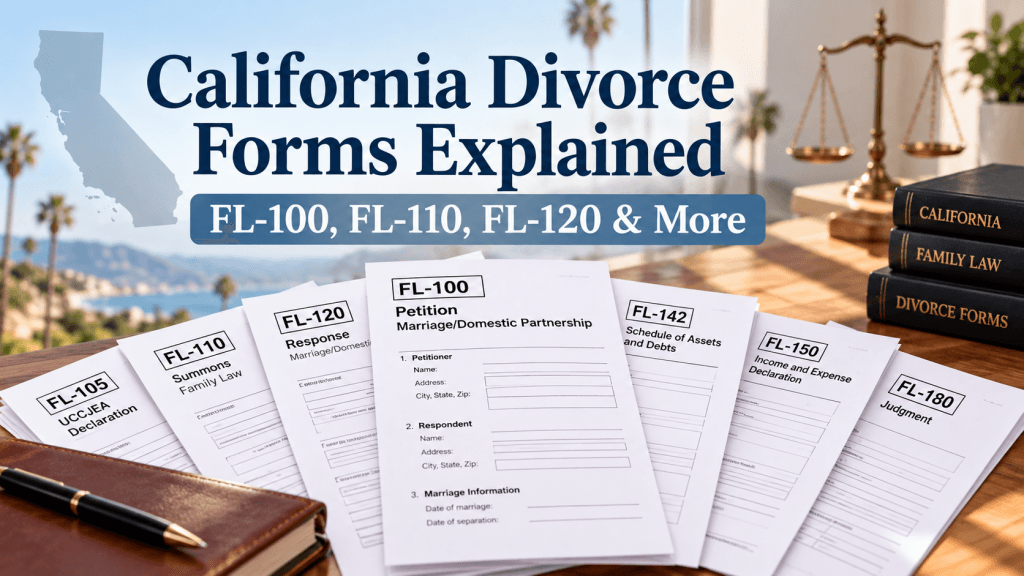
California divorce forms can feel overwhelming at first – there are dozens of Judicial Council forms, each with its own number and job. The good news is that you do not need all of them. This guide explains the California divorce forms you are most likely to use, organized by stage, so you know what each one does and when it comes into play. We cover the filing forms (FL-100, FL-110, FL-105), the response form (FL-120), the service and disclosure forms (FL-115, FL-117, FL-142, FL-150, FL-141), the fee waiver (FW-001), and the judgment forms (FL-180, FL-190).
CD&D Associates is a registered Legal Document Assistant service, not a law firm. This article provides general information, not legal advice. We prepare and file California divorce forms at your direction. Always use the current Judicial Council version of each form and check your county’s local rules.
California Divorce Forms at a Glance
Here is a quick summary of the main California divorce forms by stage. Each one is explained in more detail below.
| Form | Name | What it is for | Stage |
| FL-100 | Petition – Marriage/Domestic Partnership | Starts the divorce and lists what you request | Filing |
| FL-110 | Summons | Notifies your spouse and sets standard restraining orders (ATROS) | Filing |
| FL-105 | Declaration Under UCCJEA | Generally required when you and your spouse have minor children together | Filing |
| FW-001 | Request to Waive Court Fees | Asks the court to waive the filing fee | Fees |
| FL-120 | Response – Marriage/Domestic Partnership | The respondent’s answer to the petition | Response |
| FL-115 | Proof of Service of Summons | Proves the petition and summons were served | Service |
| FL-117 | Notice and Acknowledgment of Receipt | Used for service by mail when the spouse signs | Service |
| FL-140 | Declaration of Disclosure | Cover sheet for the financial disclosures you exchange | Disclosure |
| FL-142 | Schedule of Assets and Debts | Lists everything you own and owe | Disclosure |
| FL-150 | Income and Expense Declaration | Shows your income and monthly expenses | Disclosure |
| FL-160 | Property Declaration (optional) | Extra space to list property and debts | Disclosure |
| FL-141 | Declaration Regarding Service of Disclosure | The disclosure-related form you file with the court to show the disclosure documents were served | Disclosure |
| FL-300 | Request for Order | Asks the court to make or change certain family law orders | Motions |
| FL-165 | Request to Enter Default | Used when a spouse does not respond | Default |
| FL-180 | Judgment | The Judgment form that becomes part of the court’s final orders in the divorce | Judgment |
| FL-190 | Notice of Entry of Judgment | Notice that the Judgment has been entered | Judgment |
Form numbers and names are Judicial Council of California forms. Some cases need additional forms; others need fewer. Always confirm the current version on the California Courts website.
Forms to Start Your Divorce (Filing)
FL-100 – Petition – Marriage/Domestic Partnership. This is the form that starts your California divorce. It states that you are asking to end the marriage and lists what you want for property, support, and your children.
FL-110 – Summons. The summons notifies your spouse that a case has begun. It also activates standard restraining orders (known as ATROS) that keep both spouses from moving money, selling property, or taking the children out of state while the case is pending.
FL-105 – Declaration Under UCCJEA. Generally required when you and your spouse have minor children together. You file it with your petition to give the court information about where the children have lived.
Fee Waiver Forms (If You Cannot Afford the Fee)
Filing a divorce in California usually requires a first-appearance filing fee of about $435 to $450, depending on the county. If you cannot afford it, you file the Request to Waive Court Fees (FW-001); if the court approves, it issues an Order on Court Fee Waiver (FW-003) and your fee is waived. For a full breakdown, see our divorce cost and filing fees guide.
The Response Form (FL-120)
If you are the spouse who received the divorce papers, you respond with the FL-120, Response – Marriage/Domestic Partnership. You generally have 30 days from the date you were served to file it. The FL-120 mirrors the petition and lets you tell the court what you want. Our guide on responding to divorce papers explains the FL-120 in detail.
Service Forms (Proving Delivery)
FL-115 – Proof of Service of Summons. After your spouse is served, the server completes this form to prove how, when, and where the papers were delivered. It is then filed with the court.
FL-117 – Notice and Acknowledgment of Receipt. Used for service by mail. The spouse signs and returns it to confirm they received the papers.
For how service actually works, including who can serve and the different methods, see our guide on how to serve divorce papers in California.
Financial Disclosure Forms
Both spouses must exchange financial disclosures. The disclosure forms themselves are served on your spouse rather than filed with the court. You then file a single declaration (FL-141) with the court to confirm the exchange.
FL-140 – Declaration of Disclosure. The signed cover sheet for the financial disclosures you share with your spouse.
FL-142 – Schedule of Assets and Debts. Lists everything you own and owe. You may use FL-160 instead.
FL-150 – Income and Expense Declaration. Shows your income and your monthly expenses. It is commonly used when the court needs income and expense information for issues such as child support, spousal support, or attorney fees.
FL-160 – Property Declaration (optional). Can be used in place of FL-142 to list property and debts.
FL-141 – Declaration Regarding Service of Declaration of Disclosure. This is the disclosure-related form you file with the court to show the required disclosure documents were served on your spouse. The disclosures themselves are not filed.
Our guide to financial disclosure requirements explains each disclosure form and the deadlines.
Request for Temporary Orders (FL-300)
The Request for Order (FL-300) asks the court to make or change certain family law orders. You use it when you need the court to decide something while the divorce is pending – such as temporary custody, support, or use of the home – and also later to change an existing order. Filing it sets a court date. Child custody requests often include the FL-311 attachment.
If a Spouse Does Not Respond (Default)
If the other spouse does not file a response within 30 days, you may be able to proceed by default using the Request to Enter Default (FL-165). We explain the default process in our dedicated default divorce guide.
Judgment Forms (Finalizing the Divorce)
FL-180 – Judgment. The Judgment form that becomes part of the court’s final orders in the divorce.
FL-190 – Notice of Entry of Judgment. The notice that the Judgment has been entered.
Additional final forms and attachments depend on whether the case is a default, an uncontested agreement, or contested; a default judgment commonly also includes the Declaration for Default or Uncontested Dissolution (FL-170). Remember that marital status does not end immediately just because the judgment paperwork is prepared – a California divorce cannot be final until at least six months have passed from the applicable triggering event.
Which California Divorce Forms Do You Actually Need?
The exact forms depend on your situation:
- A petitioner typically starts with FL-100 and FL-110.
- Add FL-105 if you and your spouse have minor children together.
- Add FW-001 if you need a fee waiver.
- Both spouses complete financial disclosures (FL-140, FL-142 or FL-160, and FL-150), with FL-141 to show service.
- A respondent who chooses to participate typically files FL-120.
- Finalizing the case commonly involves FL-180 and FL-190, along with any required attachments and case-specific forms.
If the amount of paperwork feels like a lot, you are not alone – choosing and completing the right California divorce forms is one of the most common reasons people turn to a Legal Document Assistant.
How CD&D Associates Can Help
You do not have to figure out the forms on your own. CD&D Associates prepares and files your California divorce forms – the petition, the response, disclosures, service documents, and judgment paperwork – as part of our divorce document preparation service, at a flat fee for document preparation. We serve Santa Maria, Lompoc, Buellton, and all of California by phone or Zoom. For contested or complex cases, the California courts recommend consulting an attorney. Not sure which forms you need? Contact us for a free consultation.
Frequently Asked Questions
What forms do I need to file for divorce in California?
The petitioner starts with the Petition (FL-100) and Summons (FL-110). You add the UCCJEA declaration (FL-105) if you and your spouse have minor children together, financial disclosure forms (FL-140, FL-142 or FL-160, FL-150, and FL-141), and later the judgment forms (FL-180 and FL-190). The responding spouse files the Response (FL-120).
What is Form FL-100?
FL-100 is the Petition that starts a California divorce. It lists the marriage details and what you are requesting for property, support, and children.
What is the difference between FL-100 and FL-120?
FL-100 is the Petition filed by the spouse who starts the case. FL-120 is the Response filed by the other spouse to answer it.
What is Form FL-150 used for?
FL-150 is the Income and Expense Declaration. It shows your income and monthly expenses and is used for child support and spousal support calculations.
How much is the California divorce filing fee?
The first-appearance filing fee is usually about $435 to $450, depending on the county. If you cannot afford it, you can request a fee waiver with Form FW-001.
Where can I get California divorce forms?
The official Judicial Council forms are available free on the California Courts website. A Legal Document Assistant such as CD&D Associates can also prepare and file them for you at your direction.