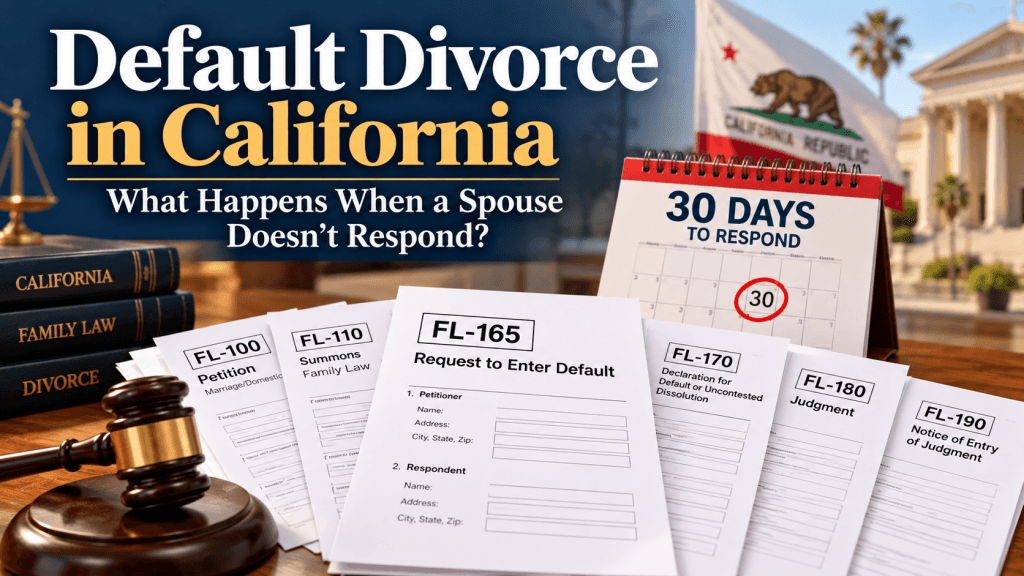
Filing for divorce in California does not depend on your spouse cooperating. If you serve your spouse with divorce papers and they do not respond within the time allowed, you may be able to move forward without them through a default divorce. This guide explains what a default divorce in California is, the 30-day response deadline that triggers it, the forms you use to request one (including the FL-165 Request to Enter Default), the steps and timeline, and the risks to understand before you proceed.
CD&D Associates is a registered Legal Document Assistant service, not a law firm. This article provides general information, not legal advice. We prepare and file California divorce forms at your direction. Always use the current Judicial Council version of each form and check your county’s local rules.
What Is a Default Divorce in California?
A default divorce involves two parts: the spouse who was served does not file a Response within the deadline, and the filing spouse then asks the court to enter their default. Because the other spouse did not participate, the court can decide the case based on the petition and California law, without that spouse getting to present their side. Default is one of the common ways uncooperative or unreachable cases are finalized, and it is a normal, built-in part of the California process – not a penalty or a trick.
A default does not mean the divorce is instantly granted. The filing spouse (the petitioner) still has to complete a judgment packet, and a judge still has to review and sign it before the divorce is final.
The 30-Day Response Deadline
After you serve your spouse, they generally have 30 days to file a Response (Form FL-120). If that window passes and they have filed nothing and you have no written agreement, you can ask the court to enter their default. For how service starts this clock, see our guide on how to serve divorce papers in California. You should confirm the exact deadline for your case, because the clock runs from the date of valid service.
The Three Paths: Default, Default With Agreement, and Uncontested
California sorts cases where the other spouse does not formally contest into three paths. Knowing which one fits your situation tells you which forms you need.
| Path | What it means | Key forms |
| True default | Served spouse files no Response within 30 days and there is no written agreement. The judge decides on the petition and the law alone. | FL-165, FL-170, FL-180, FL-190 |
| Default with agreement | Served spouse files no Response, but both spouses sign a written settlement agreement that is submitted to the court. | FL-165, FL-170, FL-180, FL-190 + agreement attachments |
| Uncontested | Served spouse files a Response (FL-120), and both spouses agree on all terms. This is not a default. | FL-120, FL-170, FL-180, FL-190 |
Form combinations vary by case type and whether children are involved. Always confirm the current forms and your county’s requirements on the California Courts website.
How to Request a Default (Form FL-165)
Once the 30-day response period has passed with no Response on file, the petitioner asks the court to enter the other spouse’s default. The main form is the FL-165, Request to Enter Default. In broad terms, the process looks like this:
- Confirm the 30-day response period has ended and no Response has been filed.
- Complete and file the Request to Enter Default (FL-165), which asks the court clerk to formally note that your spouse did not respond.
- Prepare your judgment packet (see below) and submit it for the judge to review.
- Wait for the judge to sign the Judgment, then serve and file the Notice of Entry of Judgment.
The exact forms and local steps vary by county, and some courts have their own checklists, so confirm the requirements for the court handling your case.
The Default Judgment Packet (FL-170, FL-180, FL-190)
Entering the default is only the first step. To actually end the marriage, you submit a judgment packet for the judge to review.
FL-170 – Declaration for Default or Uncontested Dissolution. A sworn statement that supports your requested judgment when there is no trial. It tells the court the facts it needs to grant the divorce by default or by agreement.
FL-180 – Judgment. The Judgment form that becomes part of the court’s final orders in the divorce, covering property, support, and, where relevant, children.
FL-190 – Notice of Entry of Judgment. The court mails this after the judgment is entered. It confirms the judgment and the date marital status ends, if applicable.
Default and uncontested cases share the FL-170 declaration, which is why a clean, complete packet is what gets a judgment signed without a hearing. For an overview of every California divorce form and how they fit together, see our California divorce forms guide.
Do You Still Need Financial Disclosures in a Default?
This is the point most online guides skip. Even when your spouse never responds, California still requires the filing spouse to complete and serve a preliminary declaration of disclosure, which includes a Schedule of Assets and Debts (FL-142) and an Income and Expense Declaration (FL-150), with a declaration regarding service (FL-141) filed with the court. In a true default, the non-responding spouse is generally not required to serve disclosures back because they never filed a Response. In a default with agreement, the non-responding spouse does share financial information as part of reaching that agreement. Skipping the required disclosures can cause a default judgment to be rejected or later challenged, so this step matters.
Whether the filing spouse’s final declaration of disclosure can be waived depends on the case path and the required form and process. In a default with agreement, both spouses may be able to waive the final disclosure using a mutual waiver (FL-144) if they qualify and both sign. Confirm which disclosure requirements apply to your path before you file.
Our guide to what happens after divorce papers are filed walks through the disclosure stage in more detail.
Custody, Child Support, and Support in a Default Case
A default does not let you request anything you want. In a true default, the court can generally only grant what you asked for in your petition, so the relief is limited to what the other spouse was put on notice of. Requests involving children – custody, visitation, and child support – get extra scrutiny, because the judge must still protect the children’s best interests and apply the state child support guideline regardless of whether the other parent participated. If children or support are involved, make sure your petition and judgment paperwork request them clearly and completely.
One important limitation: if you served your spouse by publication or posting because you could not locate them, the court’s ability to make certain orders – such as support or transferring property – may be limited. Confirm what relief is available for your service method before you rely on a default judgment.
How Long Does a Default Divorce Take in California?
Even with a spouse who never responds, California still requires the minimum six-month waiting period, generally measured from service or the respondent’s appearance, whichever applies under the case. That waiting period is set by state law and applies to default cases too. In practice, the total time also depends on how quickly you prepare the paperwork and how long your county court takes to review the judgment packet. You remain legally married until the judge signs and files the Judgment.
Can a Default Divorce Be Stopped or Set Aside?
Yes, in some situations. Before a default is entered, the other spouse can usually still file a Response and participate. After a default or a default judgment is entered, the other spouse may ask the court to set it aside – for example, on grounds such as mistake, surprise, excusable neglect, or a lack of actual notice. Set-aside requests require a specific legal ground and are subject to strict deadlines. Because a default obtained without proper service or disclosures can be vulnerable to a set-aside, getting service and disclosures right the first time is important.
If You Received Divorce Papers: Your Options
If you are the spouse who was served, doing nothing lets the other side proceed by default and decide the terms without your input. If you want to participate in decisions about property, support, or children, filing a Response (FL-120) within the deadline allows you to take part in the case. If you and your spouse already agree on everything, a default with agreement or an uncontested path may be simpler and cheaper than a contested case.
How CD&D Associates Can Help
A default divorce has several moving parts – the Request to Enter Default, the judgment packet, and the required disclosures – and missing or incorrect forms can cause the court to return the judgment packet for correction. CD&D Associates prepares and files your California default divorce paperwork as part of our divorce document preparation service, at a flat fee for document preparation. We serve Santa Maria, Lompoc, Buellton, and all of California by phone or Zoom. For contested or complex cases, the California courts recommend consulting an attorney. Not sure whether a default is right for your situation? Contact us for a free consultation.
Frequently Asked Questions
What is a default divorce in California?
A default divorce occurs when the served spouse does not file a Response and the petitioner asks the court to enter default. The case may then proceed as a true default or as a default with agreement, and the court can decide it based on the petition and the law.
What happens if my spouse does not respond to the divorce papers?
After 30 days with no Response, you can ask the court to enter their default using Form FL-165, then submit a judgment packet for a judge to review and sign. The divorce can be finalized without your spouse’s participation.
What is Form FL-165 used for?
FL-165 is the Request to Enter Default. It asks the court clerk to formally note that the other spouse did not file a Response within the required time, which lets the case move toward a default judgment.
How long does a default divorce take in California?
California’s minimum six-month waiting period generally runs from service of the summons and petition or the respondent’s appearance, depending on the case. The real-world total also depends on how fast the paperwork is prepared and how long the court takes to review the judgment.
Do I still need financial disclosures if my spouse does not respond?
Yes. The filing spouse must still complete and serve a preliminary declaration of disclosure (including FL-142 and FL-150) and file the declaration regarding service (FL-141). Skipping it is a common reason a default judgment is rejected.
Can a default divorce judgment be undone?
Sometimes. A spouse may ask the court to set aside a default or default judgment – for example, if they were never properly served – but it is subject to deadlines and specific legal grounds, so it is not guaranteed.