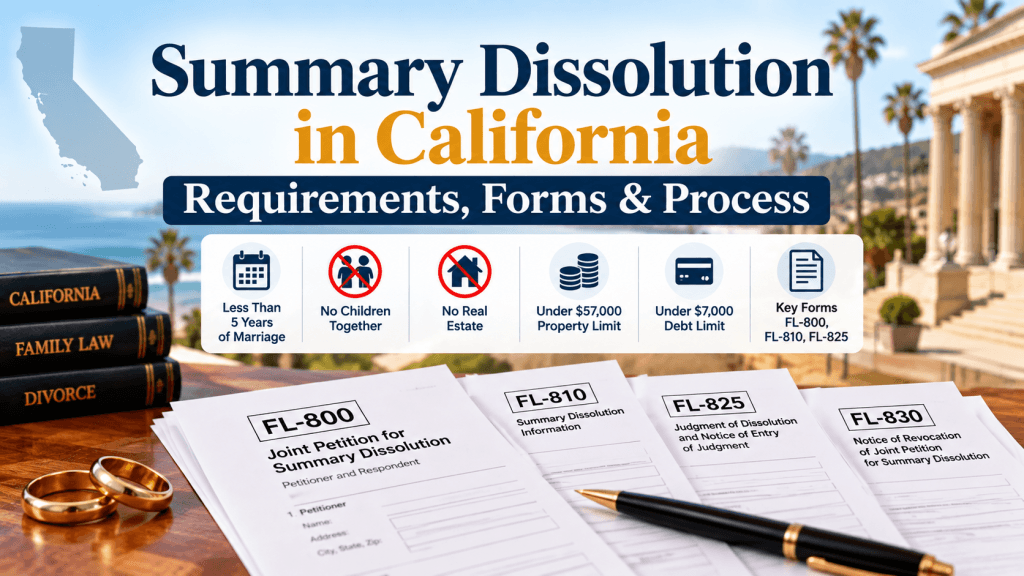
If you and your spouse were married a short time, have no children together, and own very little, California offers a streamlined way to end the marriage called a summary dissolution. It uses a single joint petition instead of the standard back-and-forth, and both spouses file together. This guide explains what a summary dissolution is, the exact requirements to qualify, the forms you file (starting with the FL-800 Joint Petition), the step-by-step process, the six-month waiting period, and the important trade-offs to weigh before you choose it.
CD&D Associates is a registered Legal Document Assistant service, not a law firm. This article provides general information, not legal advice. We prepare and file California divorce forms at your direction. Always use the current Judicial Council version of each form and check your county’s local rules, because the dollar limits and fees can change.
What Is a Summary Dissolution?
A summary dissolution is a simplified divorce (or domestic partnership termination) for couples who meet a strict set of requirements. Instead of one spouse filing a petition and serving the other, both spouses sign and file a single joint petition together. There is no Response to serve, and in most cases no court hearing.
A summary dissolution is filed jointly, but it is not the same as California’s joint petition divorce (Forms FL-700 and FL-710). The joint petition divorce is a separate cooperative-divorce process available since January 1, 2026 for couples who agree on their final terms but do not necessarily meet the strict summary dissolution limits. This guide covers summary dissolution; if you do not qualify for it, the joint petition divorce may be another option to look into.
Do You Qualify for a Summary Dissolution?
Summary dissolution is only available if every one of the following is true. If even one does not apply to you, you cannot use it and would file a standard divorce instead.
| Requirement | The rule (all must be true) |
| Length of marriage | Under 5 years from the date of marriage or registration to the date of separation. |
| Children | No children together under 18 (born or adopted), and neither spouse is pregnant now. |
| Real estate | Neither spouse owns or leases a house, land, or building (a rental lease ending within a year of filing is allowed). |
| Community property | Property acquired together during the marriage is worth less than $57,000, not counting cars. |
| Separate property | Each spouse’s own property (before marriage or after separation, including gifts and inheritances) is worth less than $57,000, not counting cars. |
| Debts | Debts taken on from marriage to separation total less than $7,000, not counting car loans. |
| Spousal support | Both spouses give up (waive) the right to spousal support. |
| Agreement | Both spouses agree to end the marriage and sign a written agreement dividing property and debts. |
| Residency | One spouse has lived in California for 6 months and in the filing county for 3 months (special rules apply to some partnerships and marriages). |
Dollar limits and residency rules are set by California law and can change. Retirement accounts such as 401(k)s and pensions count toward the property totals. Always confirm the current figures on the California Courts website before you file.
Summary Dissolution vs. Regular Divorce
Here is how a summary dissolution compares with a standard California divorce at a glance.
| Feature | Summary Dissolution | Regular (Standard) Divorce |
| Who it is for | Short marriages, no kids, low assets and debts | Any divorce, including longer marriages and children |
| Main petition form | FL-800 (joint) | FL-100 (one spouse files) |
| Response (FL-120) | Not needed – filed jointly | The other spouse can file a Response |
| Spousal support | Both must waive it | Can be requested |
| Waiting period | At least 6 months | At least 6 months |
| Can be canceled | Either spouse can revoke with FL-830 | Dismissed or settled through the case |
The Forms You Need
FL-810 – Summary Dissolution Information. The booklet both spouses must read before filing. It explains the process and your rights, including the effect of ending the marriage this way.
FL-800 – Joint Petition for Summary Dissolution. The main form. Both spouses complete and sign it together to ask the court to end the marriage, along with a written property agreement dividing what you own and owe.
FL-825 – Judgment of Dissolution and Notice of Entry of Judgment. The form the court uses to finalize the case and notify both spouses that the marriage has ended.
FL-830 – Notice of Revocation of Petition for Summary Dissolution. The form either spouse files to stop the summary dissolution before it becomes final.
For how these fit alongside the rest of the California divorce forms, see our California divorce forms guide.
The Summary Dissolution Process, Step by Step
- Both spouses read the FL-810 Summary Dissolution Information booklet.
- Confirm you meet every eligibility requirement in the table above.
- Complete the FL-800 Joint Petition and a written property agreement that divides your property and debts.
- File the joint petition with the court and pay the filing fee (one fee for the joint filing).
- Wait at least six months. If neither spouse revokes, the court can enter the judgment (FL-825) and the marriage ends.
The first-appearance filing fee is usually about $435 to $450, and a fee waiver may be available if you cannot afford it. See our divorce cost and filing fees guide for the full picture.
The Six-Month Wait and Your Right to Change Your Mind
A summary dissolution is not final right away. The marriage does not end until at least six months after the joint petition is filed, and the court enters the judgment. During that six-month window, either spouse can change their mind and stop the process by filing a Notice of Revocation (FL-830). Filing it cancels the summary dissolution. If you still want to divorce after revoking, you can file a standard divorce instead.
Before You Waive Spousal Support
One requirement deserves extra thought: in a summary dissolution, both spouses permanently give up the right to spousal support. That waiver is a real decision, not a formality. If spousal support may be an issue – because of a large income gap, a career break, or a health or work situation – consider reviewing your options with a qualified family law attorney before choosing summary dissolution. The same caution applies to assets or debts you are unsure about: leaving something out of the property agreement can cause problems later.
What If You Do Not Qualify?
If you miss even one requirement – a marriage over five years, children together, a home you own, or assets above the caps – summary dissolution is off the table, but a cooperative divorce can still be simple. California’s joint petition divorce (Forms FL-700 and FL-710), available since January 1, 2026, lets agreeing couples file together even when they do not meet the summary dissolution limits. An uncontested divorce is another path for spouses who agree on everything and want to finalize a standard divorce without a courtroom fight. If you are not ready to end the marriage, a legal separation is an option too. The right path depends on your facts.
How CD&D Associates Can Help
A summary dissolution is simpler than a standard divorce, but the eligibility rules are strict and the property agreement has to be done right. CD&D Associates can help you prepare summary dissolution documents – the FL-800 joint petition, the property agreement, and the judgment – based on the eligibility information and instructions you provide, as part of our divorce document preparation service, at a flat fee for document preparation. We serve Santa Maria, Lompoc, Buellton, and all of California by phone or Zoom. For contested or complex situations, the California courts recommend consulting an attorney. Not sure which path fits your situation? Contact us for a free consultation.
Frequently Asked Questions
What is a summary dissolution in California?
It is a simplified, joint divorce for couples who were married less than five years, have no children together, and own and owe very little. Both spouses file one joint petition (FL-800) together instead of one spouse serving the other.
How long does a summary dissolution take in California?
At least six months. The marriage cannot end until six months after the joint petition is filed, even when everything else is ready.
How much does a summary dissolution cost in California?
The court filing fee is usually about $435 to $450 for the joint petition, and a fee waiver may be available if you cannot afford it. A Legal Document Assistant can prepare the paperwork for a separate flat fee.
Is a summary dissolution the same as a joint petition for divorce?
No. They are two separate California processes. Summary dissolution (Form FL-800) is only for couples who meet strict limits on marriage length, children, property, and debt. The joint petition divorce (Forms FL-700 and FL-710), available since January 1, 2026, is a broader cooperative path for couples who agree on their final terms but do not necessarily qualify for summary dissolution.
Can I stop a summary dissolution after filing?
Yes. During the six-month waiting period, either spouse can file a Notice of Revocation (FL-830) to cancel the summary dissolution. You can then file a standard divorce if you still want one.
What happens if we do not qualify for a summary dissolution?
You would file a standard divorce. If you agree on everything, an uncontested divorce is still a simpler path, and a legal separation is an option if you are not ready to end the marriage.